
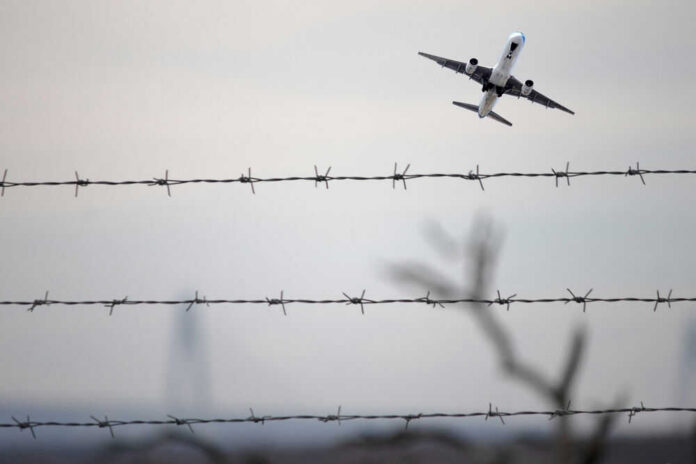
(RightwingJournal.com) – The UAE’s brief “partial reopening” of its airspace didn’t restore normal travel—it exposed how fast modern aviation can snap from departure boards to dead stops when missiles and drones enter the picture.
Story Snapshot
- UAE authorities allowed a narrow window of “exceptional” flights on March 2, 2026, mainly to move stranded travelers, cargo, and reposition aircraft.
- Airlines and airports issued mixed messages—some public notices warned of full suspensions even as a limited number of wide-body flights departed.
- Scheduled commercial service largely remained canceled, leaving thousands stuck and forcing travelers to rely on direct airline contact rather than airport arrivals.
- Security risks escalated after drone activity near UAE airport infrastructure, reinforcing why regulators kept permissions tightly controlled.
Why “Limited Reopening” Still Looked Like Chaos for Travelers
UAE airspace restrictions shifted quickly after regional tensions surged, and that whiplash is the main reason passengers reported confusion. On March 2, the UAE permitted a narrow set of flights to operate from Abu Dhabi and Dubai under strict approvals, but the goal was not a true return to business as usual. Airlines focused on clearing backlogs, repatriating travelers, moving cargo, and repositioning aircraft rather than restoring normal schedules.
Because those flights were exceptions—not routine departures—public-facing airline updates sometimes read like contradictions. One high-profile example described by reporting was Etihad’s public notice indicating broad suspension while aircraft still departed within the approved window. Flight tracking interest spiked as people tried to confirm what was real-time operational reality versus an alert written for the general public. In plain terms: the system prioritized safety and control over convenience.
What Actually Flew: “Exceptional” Departures and Tight Controls
Flight activity that did occur centered on Abu Dhabi first, with a notable long-haul departure to London and additional wide-body movements over a short time window. Dubai and Sharjah later saw limited operations as well, but airlines and airport authorities emphasized that travelers should not show up without confirmation. Some flights served transit-clearing priorities, and at least one major European carrier reportedly moved aircraft for operational needs without carrying passengers.
Reports also indicate that not all flight details were consistently visible to the public in the moment, adding to the sense that planes were “coming and going” without a predictable pattern. Where travelers interpreted the situation as flights “turning around,” the stronger documented point in the available reporting is rapid operational reversals: permissions opening briefly, then suspensions returning, with incomplete clarity on passenger loads and final routings for every movement.
Security Shock Behind the Disruptions: Why Regulators Stayed Restrictive
The airspace disruption was not driven by weather or routine mechanical issues; it followed direct regional security threats involving drone activity near UAE airport infrastructure. One reported incident involved an intercepted drone targeting Abu Dhabi’s airport area that resulted in casualties and injuries. With the risk environment still evolving, regulators and airport operators treated the airspace like a controlled corridor—open only enough to relieve urgent backlogs, then tightened again as conditions warranted.
That posture explains why “partial reopening” language can mislead the public. A limited opening can exist at the same time as widespread cancellations because the state is balancing air safety, air defense concerns, crew duty limits, airport staffing access, and insurance exposure. Airlines, meanwhile, have to publish conservative advisories to avoid sending thousands to terminals when gates, security lanes, and ground handling may not be ready—or may be temporarily unsafe.
The Ripple Effect: Cancellations, Stranded Families, and Supply Chain Strain
The human cost showed up immediately in mass cancellations and stranded passengers across the Gulf network, including significant disruption on routes connected to India. When a hub like Dubai slows down, the effect is not local—it hits connecting itineraries across Europe, Asia, and Africa. Cargo and aircraft positioning also become strategic priorities, because airlines must protect future schedules by getting jets and crews where they are needed once corridors reopen.
For American readers watching these events, the bigger lesson is how quickly global travel turns fragile when international security breaks down. The reports available here do not provide verified examples of passenger jets launching and then literally reversing course mid-flight in UAE airspace during this window. What they do document is a different kind of “turnaround”: rapid policy shifts, tightly limited permissions, and public messaging that can lag behind real-time operational decisions.
Sources:
UAE national carriers announce operation
Israel-Iran war: Limited flights to begin from Dubai, Abu Dhabi today amid Gulf tensions
Dubai Airports announces limited resumption of flights from DXB and DWC
Emirates to resume limited flights from March 2
US and Israeli strikes on Iran disrupt regional and international flights
Dubai-Abu Dhabi attack, airspace closure: Live news updates
Copyright 2026, RightwingJournal.com